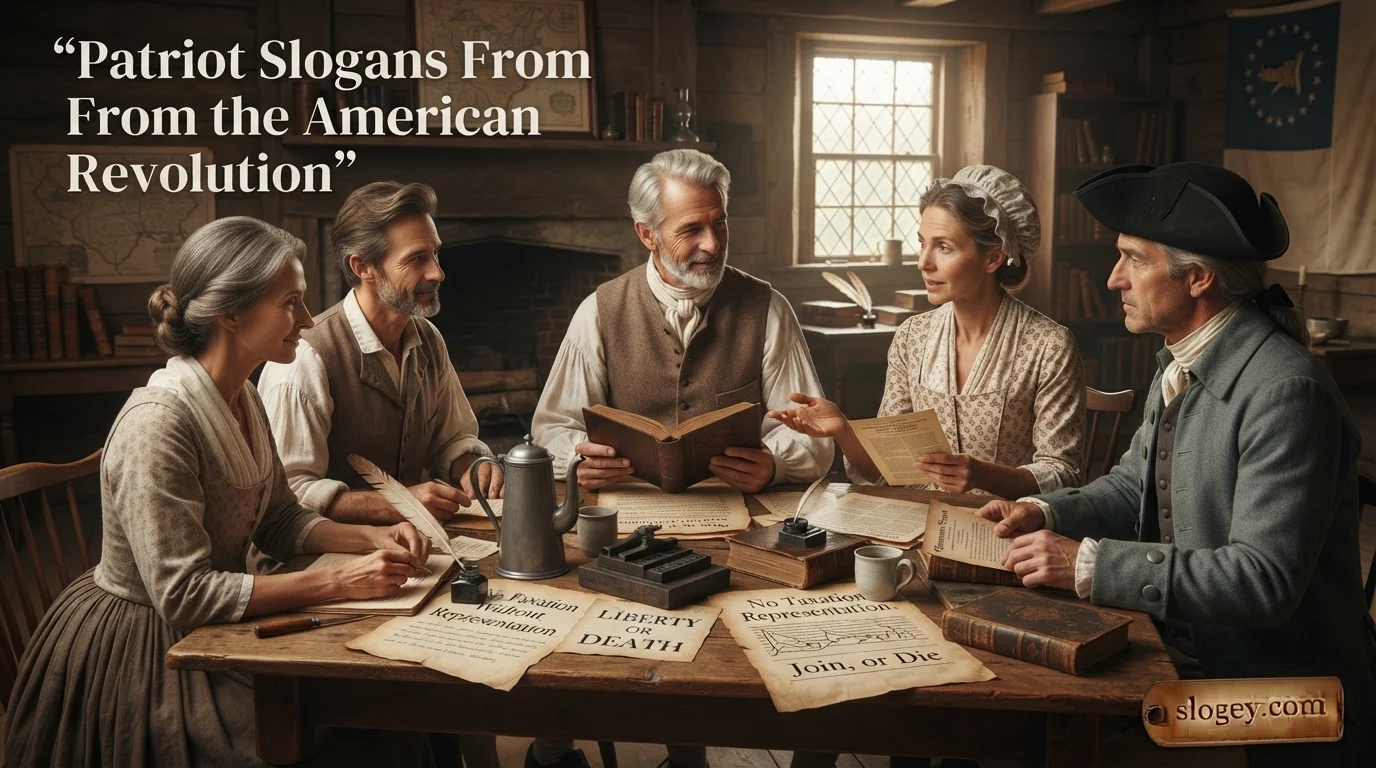
The American Revolution produced powerful words that expressed ideas about liberty, representation, independence, resistance, and unity. Many of these phrases appeared in speeches, newspapers, political cartoons, pamphlets, declarations, and public demonstrations.
If you are researching patriot slogans from the American Revolution, it is useful to separate documented historical expressions from modern phrases inspired by the period. Famous examples include Join, or Die, Don’t Tread on Me, No taxation without representation, and Patrick Henry’s Give me liberty, or give me death!
This collection brings together historically documented expressions alongside clearly labeled original, period-inspired ideas. It can be useful for students, teachers, history projects, classroom displays, patriotic events, writing projects, and anyone interested in Revolutionary-era language.
What Are Patriot Slogans From the American Revolution?
Patriot slogans from the American Revolution were short expressions, rallying cries, political messages, and memorable statements used to communicate resistance to British policies and support for colonial rights, unity, liberty, and eventually independence. Some were created before the war and later became associated with the revolutionary movement.
Not every phrase commonly described today as a Revolutionary War slogan was an official slogan used throughout the colonies. Some came from speeches or political arguments, while others appeared on newspapers, flags, cartoons, broadsides, and other printed materials. For example, Join, or Die first appeared in Benjamin Franklin’s Pennsylvania Gazette in 1754 and was later reused in the revolutionary period.
The historical context also matters. Colonists objected to taxation and other policies that they believed violated their rights. The phrase No taxation without representation became a rallying cry against taxation without direct representation in Parliament.
Famous Revolutionary Slogans and Rallying Cries
These are among the best-known expressions connected with the American Revolution. The first few are historically documented rather than newly invented slogans.
- Join, or Die
- Don’t Tread on Me
- No taxation without representation
- Give me liberty, or give me death!
- Liberty or Death
- Unite or Die
- Life, Liberty, and the pursuit of Happiness
- Free and Independent States
- Resistance to tyranny
- The cause of liberty
- The rights of Englishmen
- Natural rights
- Colonial liberty
- American liberty
- The cause of independence
- Best Pick: No taxation without representation
- Stand for liberty
- Defend your rights
- Unite for liberty
- Freedom for the colonies
Franklin’s Join, or Die cartoon originally called for colonial unity, while the snake image and its message were later adapted during the Revolution. The Library of Congress also documents the revolutionary use of Don’t Tread on Me.
Liberty Slogans From the Revolutionary Era
Liberty was central to Revolutionary-era political language. Patrick Henry’s famous 1775 declaration became one of the most recognizable expressions associated with the revolutionary cause.
- Give me liberty, or give me death!
- Liberty or death
- Liberty for the colonies
- Defend the cause of liberty
- Stand for liberty
- Liberty is worth defending
- Freedom is our cause
- Let liberty prevail
- Liberty before submission
- Liberty for every free people
- The cause of freedom
- Protect natural liberty
- Fight for colonial liberty
- Freedom shall be our aim
- Let freedom ring
- Best Pick: Give me liberty, or give me death!
- Liberty over oppression
- A people united for liberty
- The spirit of liberty
- Choose liberty
A historical note is important here: the exact text of Patrick Henry’s 1775 speech is not preserved in a contemporary manuscript. The familiar wording was reconstructed later from recollections and published by William Wirt in 1817.
No Taxation Without Representation Slogans
Taxation and representation were major points of colonial protest. The phrase No taxation without representation captured an argument that became especially prominent during opposition to measures such as the Stamp Act.
- No taxation without representation
- Taxation requires representation
- No taxes without a voice
- Representation before taxation
- A voice before a tax
- Tax us fairly
- Consent before taxation
- Rights before revenue
- No taxation without a colonial voice
- Representation is a right
- Taxation and representation belong together
- Let the colonies have a voice
- No tax without consent
- Our rights are not for sale
- Stand against unfair taxation
- Best Pick: No taxation without representation
- A free people deserve representation
- Taxation needs consent
- Representation protects liberty
- Speak before you tax
The Stamp Act of 1765 placed taxes on items including printed materials and legal documents, contributing to colonial resistance and the broader debate over representation.
Patriot Slogans About Independence
As the conflict developed, the political discussion moved from protesting particular British policies toward independence. The Declaration of Independence ultimately stated that the colonies were, and ought to be, free and independent states.
- Independence for the colonies
- Free and independent
- Let America be free
- Liberty through independence
- Independence is our cause
- Stand for independence
- A new nation begins
- Freedom from foreign rule
- United for independence
- The colonies shall be free
- Choose independence
- America seeks liberty
- Let freedom guide us
- Independence and liberty
- A free people, a free nation
- Best Pick: Free and independent
- Freedom from unjust rule
- Liberty demands independence
- United for a free America
- Build a nation of liberty
The Declaration’s language connected independence with natural rights, including life, liberty, and the pursuit of happiness.
Revolutionary War Patriotic Sayings
Many Revolutionary-era messages emphasized courage, sacrifice, duty, and commitment to the colonial cause. These original phrases are period-inspired ideas, not claims that they were documented historical slogans.
- Stand firm for liberty
- Courage for the colonies
- Defend the cause
- Liberty needs brave hearts
- Stand together and be strong
- Courage creates freedom
- Our cause is liberty
- Brave hearts build nations
- Stand for your rights
- Defend your homeland
- United hearts, united cause
- Let courage lead
- Freedom rewards courage
- Strength through unity
- Hold fast to liberty
- Best Pick: Stand firm for liberty
- Courage for a free people
- Defend what you believe
- Together for independence
- Brave hearts for a new nation
These modern formulations can be useful for educational displays, but they should not be presented as authentic eighteenth-century quotations unless a primary source supports that attribution.
Colonial Patriot Slogans
Before independence was declared, many colonial patriots framed their arguments around rights, representation, self-government, and the liberties they believed they possessed as English subjects.
- Defend colonial rights
- Stand for colonial liberty
- Let the colonies have a voice
- Protect our inherited rights
- Liberty belongs in the colonies
- United colonies, united cause
- Stand with your colony
- Defend the rights of free people
- Colonial voices must be heard
- Liberty begins with rights
- Protect local self-government
- Stand against unjust rule
- The colonies deserve a voice
- Join together for liberty
- Defend the rights of the colonies
- Best Pick: Defend colonial rights
- United for colonial freedom
- Rights cannot be ignored
- Liberty for every colony
- Let the colonies stand together
The historical dispute was not initially framed simply as a modern independence movement. Many colonists argued that their rights as English subjects were being violated, and the movement evolved over time toward independence.
Join or Die and Unity Slogans
Join, or Die is one of the most recognizable Revolutionary-era expressions. Franklin’s 1754 cartoon showed a divided snake representing the colonies, and the image was later reused in revolutionary contexts to promote unity against Britain.
- Join, or Die
- Unite or Die
- United we stand
- Join together for liberty
- United colonies, stronger cause
- One cause, many colonies
- Stand united
- Unity brings strength
- Together for freedom
- United for independence
- Join hands for liberty
- One people, one cause
- Stand together
- Strength through unity
- United against oppression
- Best Pick: Join, or Die
- Many colonies, one cause
- Unity for liberty
- Together we seek freedom
- United in the cause
The original Join, or Die image was created for a different context in 1754, but its later reuse illustrates how political symbols can acquire new meaning as circumstances change.
Don’t Tread on Me Slogans
The rattlesnake became an important patriotic symbol during the revolutionary period. The Library of Congress documents its association with the motto Don’t Tread on Me, including an appearance on a Marine drum in 1775.
- Don’t Tread on Me
- Stand your ground
- Defend your liberty
- Liberty has a warning
- Respect the rights of free people
- Do not threaten our freedom
- Stand firm for America
- Freedom will be defended
- Protect liberty
- Defend your rights
- Liberty stands strong
- A warning in the name of freedom
- The rattlesnake of liberty
- Stand firm, stay free
- Freedom does not surrender
- Best Pick: Don’t Tread on Me
- Liberty has a voice
- Do not cross the line of liberty
- Defend the cause
- Stand strong for freedom
For historical accuracy, Don’t Tread on Me is much better treated as a documented Revolutionary-era motto than as a generic modern patriotic phrase.
Declaration of Independence Slogans and Ideas
The Declaration of Independence provided some of the most influential political language of the era. Rather than functioning as a collection of short advertising-style slogans, its language presented arguments about rights, government, grievances, and independence.
- Life, Liberty, and the pursuit of Happiness
- All men are created equal
- Unalienable Rights
- Free and Independent States
- The cause of separation
- Government derives power from the people
- Defend natural rights
- Secure our liberties
- Protect the rights of the people
- Liberty belongs to all
- Freedom and self-government
- Rights cannot be surrendered
- A government accountable to the people
- Independence through self-government
- Liberty and justice
- Best Pick: Life, Liberty, and the pursuit of Happiness
- Natural rights for a free people
- A new chapter of independence
- Freedom through self-government
- The people and their rights
The National Archives explains that the Declaration’s preamble presented natural rights and that its final resolution declared the colonies free and independent states.
Modern Slogans Inspired by the American Revolution
The following are new, original phrases inspired by Revolutionary themes. They should not be presented as quotations from historical Patriots.
- Liberty Then, Liberty Always
- Inspired by the Spirit of 1776
- Freedom Has a History
- Remember the Revolutionary Spirit
- Courage Built a Nation
- Liberty Is Worth Remembering
- Honor the Fight for Independence
- Freedom Has Deep Roots
- Learn From the Revolution
- History Speaks Through Liberty
- Remember the Road to Independence
- Celebrate the Spirit of Freedom
- From Colonies to Independence
- The Story of Liberty Lives On
- Remember Those Who Sought Freedom
- Best Pick: Liberty Then, Liberty Always
- Teach the History of Independence
- Carry the Lessons of History
- Remember the Birth of a Nation
- Freedom Has a Story to Tell
These ideas work particularly well for history projects, classroom posters, museum-style displays, educational websites, and modern designs that draw inspiration from Revolutionary America without falsely attributing new wording to historical figures.
How to Create Your Own Patriot Slogans From the American Revolution
Creating a historically responsible slogan starts with understanding the language and political concerns of the period.
Choose a Historical Theme
Start with a documented theme such as liberty, representation, colonial rights, unity, independence, or natural rights. This keeps the slogan connected to the historical setting.
Know the Difference Between History and Inspiration
If you create a new phrase, identify it as modern or period-inspired. Do not put invented words in quotation marks and attribute them to George Washington, Thomas Jefferson, Benjamin Franklin, Patrick Henry, or another historical figure without reliable evidence.
Keep the Message Short
A strong slogan usually communicates one central idea. Words such as liberty, freedom, rights, unity, representation, and independence can help create a concise historical message.
Check Primary Sources
For schoolwork or published history content, verify famous quotations and slogans with reliable sources. The Library of Congress and National Archives provide primary-source collections and historical explanations that can help distinguish authentic material from later popularized versions.
FAQs: About Patriot Slogans From the American Revolution
What was the most famous Revolutionary slogan?
There was no single official slogan used by all Patriots. No taxation without representation, Join, or Die, Don’t Tread on Me, and Give me liberty, or give me death! are among the best-known expressions associated with the era.
What did No taxation without representation mean?
It expressed colonial opposition to taxation by Parliament without direct colonial representation there.
Who created Join, or Die?
Benjamin Franklin published the famous woodcut in the Pennsylvania Gazette in 1754.
What does Don’t Tread on Me mean?
It was a warning associated with the rattlesnake symbol during the Revolutionary period and expressed resistance and willingness to defend liberty.
Who said Give me liberty, or give me death?
The statement is attributed to Patrick Henry in his famous 1775 speech before the Virginia Assembly. The exact contemporary text of the speech, however, does not survive.
Were all Revolutionary slogans officially adopted?
No. Revolutionary political language came from many sources, including newspapers, speeches, political cartoons, pamphlets, declarations, and public debate.
Where can I research authentic Revolutionary slogans?
The Library of Congress and National Archives are useful starting points because they provide digitized historical documents, newspapers, images, and explanatory material.
Conclusion
Patriot slogans from the American Revolution reflected a changing political movement centered on rights, representation, liberty, unity, and independence. Famous expressions such as Join, or Die, Don’t Tread on Me, and No taxation without representation remain closely connected with the period because historical sources document their use and development.
For history projects and educational content, accuracy matters as much as memorability. When using Revolutionary slogans, distinguish authentic historical expressions from modern phrases inspired by the era, and use primary sources whenever possible to understand what Patriots actually wrote, said, and published.

I am Bobby James, the Administrator at Slogey. I enjoy creating, organizing, and sharing memorable slogans that help readers express ideas clearly, creatively, and confidently.